A beautiful living room with hardwood floors and minimal furniture can sound surprisingly loud. You hear voices echoing longer. The TV seems to be turned up louder than necessary.
This quickly raises the question: does acoustic wall decor made of PET felt really reduce reverberation? The short answer is yes. PET felt has been proven to absorb sound and thereby reduce reverberation. How much of a difference you notice depends on your space and how much acoustic surface area you add. So it’s not a miracle cure, but it is a material that delivers on its promise.
Discover our acoustic felt panels
Why Echoes Occur
Sound travels through a space in waves. When those waves hit a hard surface, they bounce back instead of being absorbed.
This happens with glass, concrete, plastered walls, and hard floors. The more of these types of surfaces a room has, the more often the sound keeps bouncing around. You hear this as reverberation: sound that lingers instead of fading away.
Modern interiors are often particularly prone to this. We love large windows, open spaces, and a calm, uncluttered design. It’s beautiful to look at, but acoustically, it’s not always the best choice.
Soft materials have the opposite effect. A rug or a fabric sofa absorbs some of the sound. PET felt does the same, but in a targeted way: it’s specifically designed to function as an acoustic material.

How PET Felt Absorbs Sound
PET felt has an open, fibrous structure. Instead of reflecting sound waves back into the room, the material allows them to penetrate it.
Inside those fibers, the sound loses some of its energy due to friction. Less sound is reflected back, and reverberation builds up less intensely.
Soundproofing a room is a different matter, and this product isn’t designed for that. Acoustic wall decor isn’t meant to keep sound out, but to make the sound inside the room more pleasant.
- Conversations become easier to understand
- Sound lingers for a shorter time
- A room sounds less hollow
You’ll notice this difference most in rooms that currently have few soft materials.
The Effect in Numbers
Yes, and that’s exactly why we don’t leave it as an assumption.
FeltArt has been tested for sound absorption and achieves a Noise Reduction Coefficient (NRC) of up to 0.85. This scale ranges from 0 to 1: the higher the number, the more sound a material absorbs.
A single piece of art on the wall doesn’t automatically solve every acoustic problem. The NRC indicates the performance of the material itself; the final result in your room also depends on how much surface area you cover with it.
How Much Wall Decor You Need
There’s no one-size-fits-all answer to this, and we’d rather not make any empty promises than give the wrong one.
A small bedroom with lots of textiles usually needs less than a large living room with a poured concrete floor and high ceilings. The location where you hang the panels also plays a role: a large, bare wall surface is often where the most sound bounces off, making it a logical starting point.
If you’re looking for a slight improvement, even one set can make a difference. If the reverberation in your space is clearly audible, more acoustic surface area is usually needed.
So don’t view acoustic wall decor as a miracle cure per panel, but rather as a material that demonstrably absorbs sound. The more well-placed surface area you add, the greater the effect.
Why Choose Wall Decor Instead of a Standard Acoustic Panel
Because you probably don’t want a living room that looks like a recording studio.
Traditional acoustic solutions are often purely functional: gray tiles, foam, technical panels. They work great acoustically, but you have to want to look at them on your wall every day.
That’s why FeltArt wasn’t designed as a sound absorber with a splash of color, but as acoustic wall art. The material does its job for sound, while the design is meant to be a full-fledged part of your interior. So you don’t have to choose between art and acoustics. You get both.
Each of FeltArt’s eight collections plays with lines, texture, and shape in its own unique way. The four warm colors—Olive Mist, Pale Sand, Soft Dune, and Terra Bloom—make it easy to coordinate the wall decor with the rest of the room.
Where do you notice the difference the most?
Acoustic wall decor is particularly useful in spaces where there is a lot of background noise:
- A living room with an open kitchen
- A home office where you make a lot of video calls
- An office space where several people are on the phone and in meetings at the same time
Speech, in particular, falls largely within the frequency range that PET felt absorbs well. This isn’t just pleasant to the ear; it also helps you understand conversations better and reduces fatigue from the surrounding noise.
> More about our eco-friendly designs

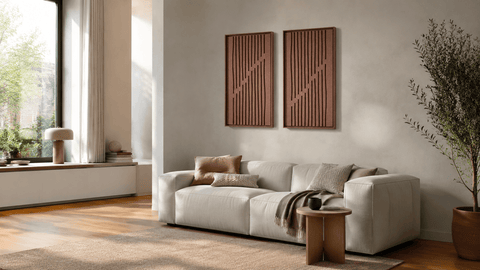
The image above shows our FeltArt Linoa L (70x110 cm) design in Terra Bloom
Practical
- Three sizes, always sold as a set of two panels: S (60 × 60 cm), M (60 × 80 cm), and L (70 × 110 cm)
- Made from high-density PET felt, ~85% post-consumer recycled material
- Simple installation system, no special tools required
- Free EU shipping from Eersel
- Prices starting at €149.95 per set
Frequently Asked Questions
Does PET felt make a room completely silent?
No. The material absorbs sound and reduces reverberation, but it does not provide sound insulation. A room becomes quieter and more intelligible, not soundproof.
How many panels do I need to see a noticeable effect?
That depends on the size of the room and the amount of hard surfaces. A single set can already make a difference in a room with slight reverberation; a room with significant reverberation requires more surface area.
Is the difference compared to regular wall art actually measurable?
Yes. FeltArt has been tested and achieves an NRC of up to 0.85, comparable to professional acoustic materials used in construction, and well above the performance of ordinary decorations or hard surfaces.
In short: it works
Yes. PET felt absorbs sound and reduces the amount of sound that bounces back into the room. As a result, reverberation is noticeably reduced.
Just how big that difference is depends on your room, the amount of acoustic wall decor, and where you place it. But the material itself does exactly what it’s supposed to do.
And that’s perhaps the biggest advantage of acoustic wall art: you don’t have to solve an acoustic problem with something that looks like an acoustic solution. With FeltArt, you add art to the wall while simultaneously creating a space that sounds more pleasant.