
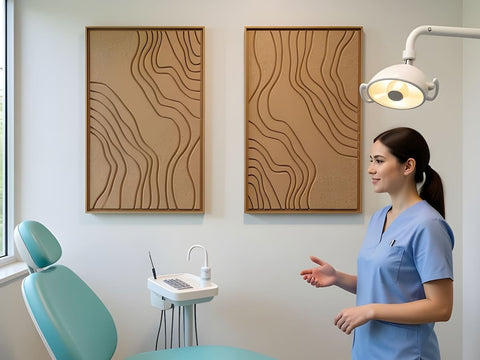
In a dental, oral care, or physiotherapy practice, everything revolves around trust, calm, and attention. Yet the space itself often works against that: hard floors, smooth walls, glass, and stainless steel create reverberation and sound that carries everywhere. The result is an environment that sounds busier and more restless than intended, precisely where calm and discretion matter most.
Acoustic wall panels solve this. In this article, we explain why practice spaces sound so hard, which concrete benefits acoustic felt panels offer to dentists, dental hygienists, physiotherapists, and other healthcare providers, and where to place them for the best effect.
Discover our acoustic felt panels
Why does a practice space often sound so hard?
A treatment room is, for good reason, furnished to be practical and easy to clean. But it is exactly those materials (tiles, laminate, glass, plastic, and metal) that reflect sound rather than absorb it. There are hardly any soft surfaces to catch sound, such as curtains or textiles.
As a result, sound keeps bouncing around the room: the hum of equipment, phone calls at the reception desk, voices from the waiting area, and conversations in the treatment room. The outcome is reverberation, a higher perceived noise level, and conversations that are both less intelligible and less private.
The benefits of acoustic wall panels in healthcare
1. Speech privacy and medical confidentiality
For medical practices, this is the most important benefit. At the desk, in the waiting area, and in the consultation or treatment room, sensitive information is discussed constantly. If those conversations carry through to the waiting room or corridor, confidentiality comes under pressure. Something that medical confidentiality and data protection rules (such as the GDPR) require you to prevent as far as possible.
Acoustic panels absorb sound and reduce how far speech travels. This keeps a conversation better contained within the room where it belongs. It is not soundproofing in a structural sense, but it noticeably supports the discretion patients expect from a healthcare practice.
The reception desk is often the most exposed point: patients share personal details, describe complaints, or make follow-up appointments while others sit a short distance away in the waiting area. Panels on the walls around the desk and between the desk and the waiting area help these conversations carry less far, without any structural alteration.
2. Less tension and a calmer feeling
Many patients feel tense before an appointment at the dentist, anxiety is a well-known phenomenon. A reverberant, noisy room amplifies that unease, while a soft, muffled acoustic has a calming effect. Sounds such as a drill, beeping equipment, or voices from another room come across as less sharp and less alarming in a well-dampened space. A calmer-sounding waiting room and treatment room contribute to a more pleasant experience and can lower perceived stress, making the visit smoother for both patient and practitioner.
3. Better intelligibility
Clear communication is essential in healthcare. Explanations about a treatment, aftercare, or medication need to come across well, including for older patients or those who are hard of hearing. Reducing reverberation makes speech more intelligible, which means fewer misunderstandings and less effortful conversations for both sides. That saves repetition, reduces the risk of errors, and makes contact more personal.
4. A more pleasant working climate for the team
Anyone who works all day in a reverberant space notices it by the end of the day. Constant ambient noise and the need to speak louder cause fatigue and reduced concentration. Better acoustics make the working environment calmer and less draining for dentists, assistants, hygienists, and reception staff.
5. A warm, professional appearance
A practice does not have to feel clinical and cold. Acoustic felt panels do their job and add atmosphere, colour, and texture. Instead of technical-looking sound absorbers, you get wall objects that make the space warmer and more polished, a detail patients associate with quality and care.

Where to place acoustic panels in a practice
The panels are mounted on the wall, away from direct treatment and contact zones, so they combine well with a practice's interior. The most effective locations:
- Waiting room: dampens conversations and ambient noise and creates a calm first impression.
- Reception desk: limits how far conversations about personal data carry towards the waiting area.
- Treatment and consultation rooms: improves intelligibility and keeps conversations more discreet.
-
Corridors and meeting rooms: counter reverberation in places where sound otherwise spreads easily.
Also valuable for other healthcare providers
What applies to the dentist applies to almost any practice where calm, privacy, and clear communication come together. A few examples:
- Physiotherapy and exercise rooms. Large, open spaces with hard floors reverberate strongly. Panels dampen the sound of several treatments at once and make the space calmer to work and move in.
- GPs and outpatient clinics. At the desk and in the waiting area, discretion is key; in the consulting room, intelligibility. Better acoustics help with both.
- Psychologists and therapists. Here confidentiality is especially important. Panels help keep sensitive conversations within the consulting room and contribute to a safe, calm atmosphere.
- Speech and hearing therapy. For speech and hearing assessments in particular, a clear, low-reverberation acoustic is essential for reliable communication and measurements.
In all these environments, the same principle applies: less reverberation, more discretion, and a more pleasant climate, without the space feeling clinical or bare.
Why FeltArt panels suit healthcare
FeltArt acoustic felt panels are designed to dampen sound and look good. For a healthcare practice, that aligns on several points:
- Calm, neutral colours. The panels come in four warm, earthy tones – Pale Sand, Soft Dune, Olive Mist, and Terra Bloom – that radiate calm and suit a professional appearance without feeling cold.
- Understated design collections. Lines such as Serene and Naturale have a calm, minimalist visual language that works well in a clinical setting.
- Sustainable material. The panels are made from high-density PET felt, of which around 85% consists of recycled post-consumer material, and are fully recyclable at the end of their life.
- Dutch design. The collection is designed in the Netherlands in collaboration with designer Juul Hagemeier.

Why felt instead of acoustic foam?
When people think of acoustics, the familiar grey foam tiles from recording studios often come to mind first. For a healthcare practice, those are rarely a good choice. Technical foam looks cheap and clinical, yellows over time, and does not match the appearance you want to present to patients.
Felt panels combine sound absorption with a polished, warm look. They function at the same time as wall art, so the investment also contributes to the atmosphere and experience of the space. Instead of something you would rather hide away, you get an element that actually makes the practice more attractive. For an environment where first impressions count, that is an important difference.
Practical: sizes and installation
FeltArt is available in three sizes, each supplied as a two-piece set:
- S – 60 x 60 cm
- M – 60 x 80 cm
- L – 70 x 110 cm
For a noticeable acoustic effect, the rule is: the more panel surface, the better – especially in rooms with hard floors and high ceilings. In a waiting room or treatment room, you can place a single larger panel as a focal point or combine several panels into a larger wall surface. Each set comes with a mounting system and is easy to install.
See the installation instructions →
Frequently asked questions
Do acoustic panels help stop conversations from carrying?
They absorb sound and reduce reverberation, so speech carries less far and conversations stay better contained within the room. It is not structural soundproofing, but it noticeably improves discretion.
Are the panels suitable for a medical environment?
The panels are mounted on the wall, away from direct treatment and contact zones. For specific requirements such as cleanability or fire rating, we are happy to advise case by case.
How many panels do I need?
That depends on the size of the room, the floor and wall materials, and the ceiling height. More panel surface gives a stronger effect. For larger practices or multiple rooms, we can advise via our trade channel.
Which colour suits a practice best?
Neutral tones such as Pale Sand and Soft Dune are a safe, calm choice. Olive Mist adds a subtle natural accent, and Terra Bloom brings warmth.
Make your practice more inviting
A dental, oral care, or physiotherapy practice deserves an environment that sounds as calm and cared-for as it looks. Acoustic wall panels improve speech privacy, reduce perceived stress, make communication clearer, and create a more pleasant climate for patients and staff, without compromising on appearance.
Want to know what acoustic panels could do for your practice? Discover the options at FeltArt.