Over the past few years, the Japandi style has grown from a niche trend into one of the most sought-after interior styles across Europe. Calm, warm, natural, and free of clutter. At MyWallArt, we regularly hear from customers that our FeltArt acoustic felt panels fit this look perfectly. And that is no coincidence.
In this article, we explain exactly what Japandi is, where the style comes from, and why felt acoustic wall panels are a logical addition to a Japandi interior, both at home and in commercial spaces. We also show which FeltArt panels suit the style best.
Discover our FeltArt collection
What is the Japandi style?
Japandi is a blend of the words Japan and Scandi (Scandinavian). It is an interior style that combines Japanese minimalism with the warmth and functionality of Scandinavian design. The result is an interior that is clean and uncluttered, yet never cold or bare.
Where pure minimalism can sometimes feel clinical, Japandi brings calm and a sense of comfort instead. The keywords are balance, simplicity, and naturalness. You see this reflected in a few clear characteristics:
- A muted, earthy colour palette. Think sand, clay, warm grey, soft olive green, and gentle terracotta. No harsh contrasts, but tones that flow seamlessly into one another.
- Natural materials. Wood, linen, ceramics, paper, stone, and felt. Materials you want to touch and that only grow more beautiful with age.
- Less, but better. Japandi is about deliberate choices. A few well-chosen objects with meaning are preferred over a room full of things.
- Craft and texture. Handmade details, visible structure, and imperfections that give a space character.
- Calm and space. Floor space kept clear, plenty of light, and an overall feeling of tranquillity.
In short: Japandi is minimalism with a soul. As functional as the Scandinavian tradition, as serene as the Japanese one.
The origins of Japandi
To understand why Japandi works so well, it helps to know where the two halves come from.
The Japanese roots: wabi-sabi and simplicity
The Japanese side of Japandi draws heavily on the philosophy of wabi-sabi: appreciating beauty in simplicity, imperfection, and impermanence. A hand-shaped bowl that is not perfectly round, a wooden table with a visible grain, a wall with a subtle texture. In the Japanese design tradition, the focus is not on perfection, but on calm, naturalness, and a connection to natural materials.
This translates into interiors with plenty of space, natural tones, low furniture, and a strong attention to light and stillness. Here, less really is more.
The Scandinavian roots: hygge and functionality
The Scandinavian design tradition emerged in the early twentieth century and became world-famous for its combination of functionality, light wood, and warmth. The well-known concept of hygge (cosiness, comfort) stands for an interior in which you feel at ease and secure. Practical, bright, and focused on comfort in countries with long, dark winters.
Where the two meet
Around the end of the 2010s, interior designers began to deliberately combine these two traditions. They turned out to be surprisingly complementary: both revolve around simplicity, natural materials, and a restrained colour palette, but where Japanese minimalism can be strict, the Scandinavian influence adds warmth and softness. That is how Japandi emerged as a style in its own right: the best of two worlds, united in one calm, timeless aesthetic.
The reason Japandi has stayed popular is not just about looks. In an era when many people work from home and long for calm, a serene, uncluttered, and warm space fits perfectly with how we want to live and work.

The overlooked element of Japandi: acoustics
Here is an aspect that is easily missed in many Japandi interiors. A clean, uncluttered space with hard floors, smooth walls, large windows, and little furniture looks beautiful, but it often sounds far less pleasant than it looks.
Sound needs soft, uneven surfaces to be absorbed. In a traditionally furnished interior, curtains, rugs, bookcases, and cushions take care of that automatically. In a minimalist Japandi interior, those soft surfaces are largely absent. The result: reverberation, echo, and a room that sounds noisier than it looks. Conversations become more tiring, video calls harder to follow, and music less enjoyable.
So the challenge is this: how do you improve the acoustics without ruining the clean, calm look of Japandi? The classic solutions, thick grey foam or technical studio panels, do exactly what you do not want. They undermine the atmosphere and turn a warm room into something clinical.
Why FeltArt panels fit a Japandi interior
FeltArt is designed to solve this problem without compromise. Our acoustic felt panels reduce echo and ambient noise, while at the same time actually adding atmosphere and texture. They are designed to work first as art and second as an acoustic solution. Exactly what a Japandi interior calls for.
There are a few reasons why felt and Japandi work so well together:
- Felt is a soft, naturally textured material. Where Japandi revolves around tactile, natural surfaces, the soft structure of felt fits in seamlessly. Each panel is precisely cut and finished by hand, in keeping with the craft-driven, wabi-sabi thinking behind the style.
- Our colours are made for this palette. FeltArt panels are available in four warm, earthy tones: Pale Sand, Soft Dune, Olive Mist, and Terra Bloom. These are exactly the muted, natural shades that form the heart of a Japandi colour scheme.
- Design with provenance. FeltArt panels are designed in the Netherlands, in collaboration with designer Juul Hagemeier. That design expertise shows in the proportions, the visual language, and the colour choices. These are not random sound absorbers, but deliberately designed wall objects.
Which FeltArt panels suit Japandi best?
The FeltArt collection consists of eight lines, each with its own visual language. For a Japandi interior, these four are the most relevant:
Serene – the most distinctly Japandi line, inspired by Japandi minimalism.
Calm, balanced shapes that fit an understated interior perfectly. Available in Pale Sand, Soft Dune or Terra Bloom. View the Serene S (60 x 60 cm), Serene M (60 x 80 cm), or Serene L (70 x 110 cm).

Estile – clean and geometric, with the same calm minimalist feel.
Ideal when you want a little more structure and line play on the wall. Available in Pale Sand, Soft Dune and Olive Mist. View the Estile S (60 x 60 cm), Estile M (60 x 80 cm), or Estile L (70 x 110 cm).

Naturale – organic, natural shapes that emphasise the wabi-sabi side of Japandi.
Warm and soft, without becoming busy. Available in Pale Sand, Soft Dune or Terra Bloom. View the Naturale S (60 x 60 cm), Naturale M (60 x 80 cm), or Naturale L (70 x 110 cm).

Oasis – softly organic with a natural flow.
Lovely as a quiet focal point above a sofa or bed. Available at MyWallArt.com in Pale Sand, Soft Dune or Terra Bloom. View the Oasis S (60 x 60 cm), Oasis M (60 x 80 cm), or Oasis L (70 x 110 cm).

Choosing the right colour
- Pale Sand and Soft Dune are the safest choice for a light, neutral Japandi interior. They keep the wall calm and let wood and textiles do the work.
- Olive Mist brings the muted green Japandi loves to use: a natural, botanical accent that never shouts.
-
Terra Bloom adds warmth and a clay-like, terracotta tone, ideal for the hygge side of the style.
How to place FeltArt in a Japandi space
Japandi loves calm and breathing room, so there is no need to fill an entire wall. A few guidelines:
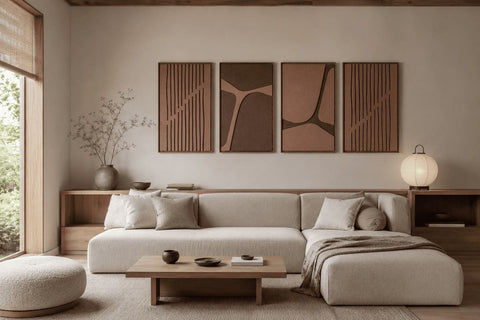
- Use a single larger panel (M or L) as a quiet centrepiece above a sofa, sideboard, or bed.
- Combine two or three smaller panels (S) in the same colour for a subtle rhythm, with enough space between them.
- Keep the surrounding wall empty: in Japandi, the panel is allowed to stand on its own.
- In an echo-prone room with a high ceiling, more panel surface works better. Choose the L size or multiple sets.
Japandi in the office and in commercial spaces
Japandi is not limited to living rooms. The style is popular in offices, practices, hospitality, and showrooms, precisely because calm and professionalism go well together. And that is exactly where acoustics play an even bigger role than at home.
FeltArt panels perform well in commercial environments such as:
- Offices and co-working spaces, where reverberation harms concentration and the clarity of conversations and video calls.
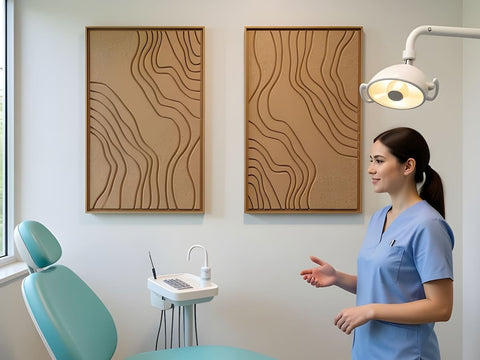
- Practices and consultation rooms, such as dental, physiotherapy, and law practices, where speech privacy matters and conversations should not carry through to the waiting area.
- Hospitality and reception areas, where excess noise directly affects the guest experience.
- Meeting rooms and studios, where acoustic control is a functional requirement.
The beauty of it is that in these spaces, FeltArt means you do not have to choose between a warm, representative look and good acoustics. You get both. For business buyers and interior professionals, we also offer a dedicated trade channel.

Practical: sizes, material, and installation
FeltArt is available in three sizes, each supplied as a two-piece set:
- S – 60 x 60 cm
- M – 60 x 80 cm
- L – 70 x 110 cm
This lets you place a single panel as an accent or combine several panels into a larger wall surface, depending on the room and the acoustic effect you are after.
The panels are made from high-density PET felt, of which no less than 85% comes from post-consumer waste, largely collected plastic that would otherwise have ended up in the ocean. That aligns with the mindful, sustainable core of the Japandi philosophy: choosing materials with meaning and a long lifespan. At the end of their life, the panels are fully recyclable and eco-friendly.
Installation is straightforward. Each set comes with a mounting system and requires no specialised tools.
See the installation instructions
Frequently asked questions
Do acoustic panels really suit a minimalist style like Japandi?
Yes. Unlike technical studio foam, FeltArt panels are designed as wall art. With their felt texture and earthy colours, they reinforce the calm of a Japandi interior rather than disrupting it.
Which FeltArt colour suits Japandi best?
Pale Sand and Soft Dune are the most neutral choice. If you want a natural accent, Olive Mist is a great option; for extra warmth, Terra Bloom works well.
Do the panels actually help against reverberation?
The panels absorb sound and reduce echo and ambient noise. The more panel surface you install, the more noticeable the effect, especially in rooms with hard floors and high ceilings.
Are the panels also suitable for commercial use?
Absolutely. They are widely used in offices, practices, and hospitality. For larger projects, there is a dedicated trade channel.
Go Japandi!
Japandi is popular because it combines calm, warmth, and simplicity into a timeless style. But a truly successful Japandi interior should sound as pleasant as it looks. That is where acoustic felt panels come in: they reduce reverberation and ambient noise while adding texture, colour, and character that fit the earthy, natural aesthetic of the style perfectly.
Want your space, at home or at the office, to sound calmer without sacrificing atmosphere? Then FeltArt panels are exactly what you are looking for.